Vacation Home Preventative Maintenance: What to Do
Vacation home preventative maintenance: regular checks, targeted interventions, and local supervision to protect your property year-round.
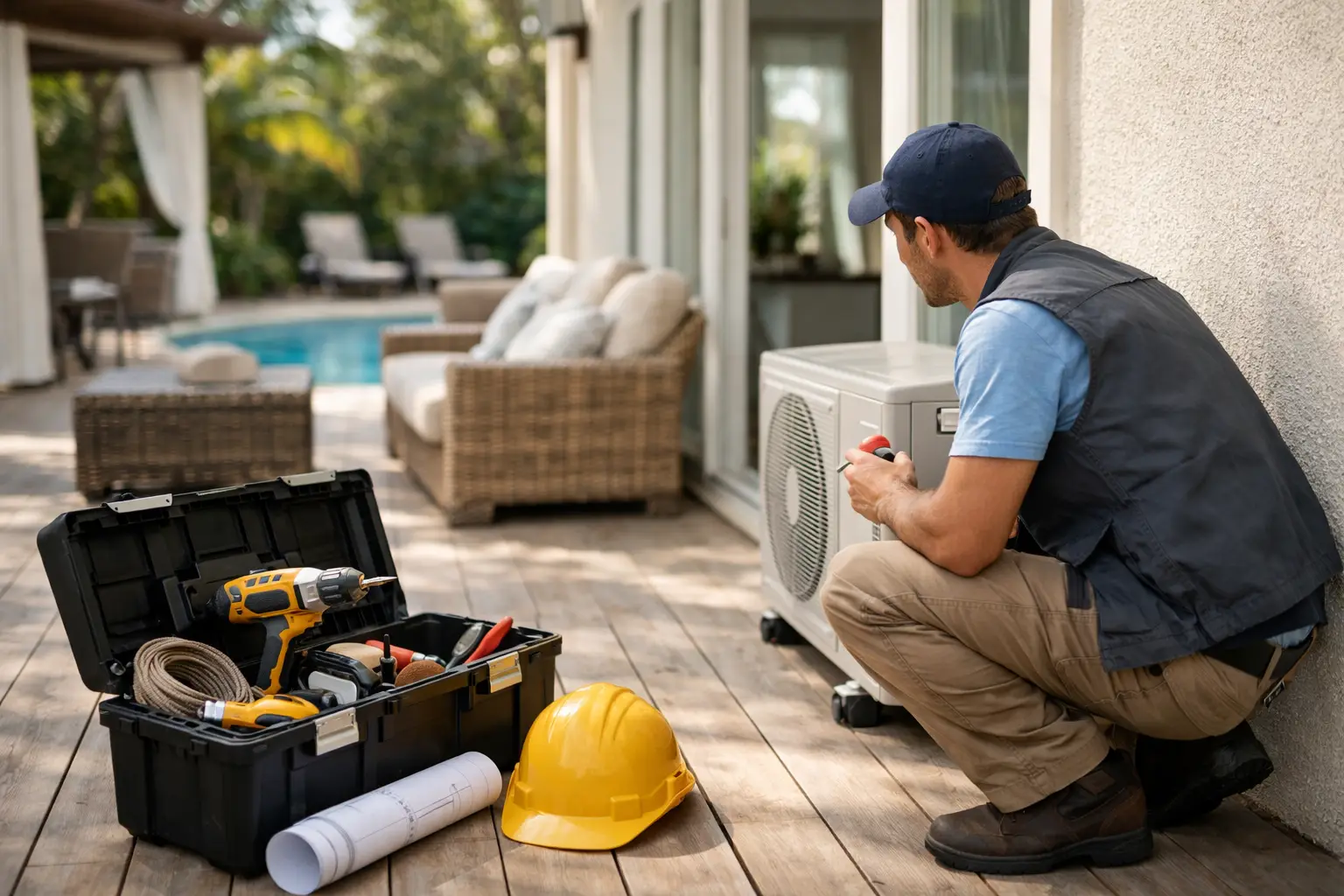
A vacation home left closed for weeks or months doesn't simply sit idle. It continues to be subjected to humidity, salt air, minor faults, temperature fluctuations, and security risks which, if not caught in time, can turn into costly problems. This is why preventative maintenance for a vacation home is not just an organizational detail, but a concrete form of property protection.
Anyone who owns a second home on Elba knows this well. When you're not there, even a minor anomaly can go unnoticed for too long. A slow leak, a blackout, a stuck shutter, infiltrations after a storm, or simply a system that doesn't start up as it should when the owners arrive. The point isn't to intervene when the damage is obvious. The point is to prevent it.
Why preventative maintenance truly changes management
Many owners associate maintenance only with extraordinary works or urgent repairs. In reality, in managing a vacation home, the value lies in continuous checks. An unoccupied property is more exposed to silent deterioration. The problem is that this type of deterioration rarely gives immediate signals.
A periodic check allows you to verify if the house is dry, secure, functional, and ready for use. It means noticing an unusual musty smell earlier, a spreading stain, a meter reporting unusual consumption, or a lock starting to fail. Every timely check reduces the risk of having to deal with more invasive interventions later.
For a vacation home, prevention protects three essential aspects: the preservation of the property, the continuity of services, and the owner's peace of mind. When these three elements are neglected, distance weighs much more heavily.
Vacation home preventative maintenance: what needs checking
Preventative maintenance for a vacation home does not equate to a single technical inspection. It is a set of practical, regular, and well-organized checks, calibrated to the type of dwelling, its location, and the time of year.
Utilities are the first sensitive point. Water, electricity, air conditioning, and hot water production must be carefully monitored. Even if everything seems off, still, or apparently in order, time can alter gaskets, drains, pressure, and basic functionality. In homes near the sea, salt air accelerates the wear of metal components, fixtures, and exterior parts.
Then there's the house's envelope. Roof, terraces, window frames, shutters, entrance doors, and drainage points require regular checks, especially after bad weather, strong winds, or long periods of closure. A clogged gutter or a window that doesn't close properly are not minor inconveniences. They can be the start of leaks, dampness, or security problems.
Interiors also deserve constant attention. Mold, condensation, bad odors, small signs of infiltration, or the presence of insects are signals that need to be read immediately. Waiting for the owner's next visit often means finding an already worsened situation.
The Elba factor: sea, climate, and not always occupied homes
On the Island of Elba, preventative maintenance takes on even greater importance. The environmental context is an extraordinary advantage for those who live or stay here, but it requires concrete vigilance for properties left vacant for long periods.
Salt air deposits and corrodes. Humidity easily enters poorly ventilated rooms. Intense rains and wind can stress roofs, exteriors, and closures. In summer, heat and discontinuous use of systems can reveal malfunctions just when the house should be ready to welcome the family. In winter, on the contrary, the problem is often the operational silence of the house: no one sees, no one hears, no one checks.
This is where local presence makes a difference. It's not enough to have a contact to call in an emergency. You need someone who knows the territory, seasonal conditions, and the typical weak points of intermittently used homes. Prevention works when it's regular, not when it only comes after a report.
Periodic checks or interventions only when needed?
At first glance, waiting for a problem to emerge may seem like the simplest choice. Fewer appointments, less organization, fewer recurring costs. But in practice, this approach exposes the owner to higher expenses and less control.
A reactive intervention is always late. When a fault is discovered late, it's often no longer about a simple repair, but extensive damage, longer technical times, and greater remote coordination. If the owner lives far away or abroad, every step becomes more complex: diagnosis, property access, authorizations, on-site presence, work monitoring.
Preventative maintenance does not eliminate every unforeseen event. No serious service should promise that. But it significantly reduces the probability that a small signal will turn into a structured problem. And this is precisely the most useful difference for a second home.
How to build an effective maintenance plan
An effective plan starts from the reality of the property, not a generic scheme. A villa exposed to the wind and near the sea does not have the same needs as a city center apartment used more often during the year. The frequency of occupancy, the presence of a garden or outdoor spaces, the age of the systems, and the finish level of the house also matter.
Generally, the first step is to define a routine of periodic inspections. The frequency depends on specific risks and periods of absence, but what matters is consistency. Each visit should include an accurate visual check, inspection of the main systems, aeration of rooms when appropriate, and detection of any anomalies.
The second step is to document. For a non-resident owner, knowing that the house has been checked is not enough. Clear communication is needed on what has been verified, any critical issues that emerged, and recommended actions. Trust grows when supervision is concrete, legible, and continuous.
The third step is the ability to react quickly. If during a check, signs of wear or an initial fault emerge, it is useful to have a local contact who can coordinate the first actions without losing time. Here the difference lies not only in technique but in organization.
Signals never to underestimate
There are obvious problems and problems that seem small only at first. A stain on the ceiling, a persistent odor, a closure that stiffens, unusual consumption, the presence of humidity in a little-used corner: these are all signs that deserve verification.
In vacation homes, the real risk is the duration of unobserved time. A detail overlooked in May can become serious damage in August, precisely when the house needs to be available. And when the property is also intended for family or friends, the issue concerns not only the preservation of the asset but also the comfort and safety of those who use it.
This is why prevention is not excessive caution. It is a criterion of responsible management.
When to entrust vacation home preventative maintenance to a local contact
If the owner lives far away, only comes to Elba occasionally during the year, or doesn't have a reliable local network, managing vacation home preventative maintenance alone quickly becomes scattered. Not so much because of the difficulty of individual checks, but because of the required continuity.
Having a local contact means knowing that the property is not left unsupervised and unguarded between stays. It also means reducing reaction times, coordinating targeted checks, and maintaining the house in a state of constant efficiency. In a context like this, the service does not replace the owner: it represents them with attention, regularity, and responsibility.
This is the approach on which Elba Property Care is based, with a model centered on programmed checks and continuous property supervision. For those who live elsewhere, it is often the most concrete solution for transforming uncertainty into real control.
Protect today to avoid chasing problems tomorrow
A second home should be a ready, reliable, and peaceful place to live, not a source of doubts every time you arrive or depart. Preventative maintenance is not about doing more than necessary. It's about doing, regularly, what avoids damage, interruptions, and urgent decisions made from a distance.
When a house is monitored over time, everything changes: it is preserved better, remains safer, and requires fewer frantic rushes against an already exploded problem. For those who are often away, this is not just good management. It is a concrete form of protection that safeguards the value of the property and the peace of mind of those who have entrusted it to local hands.