Utilities Monitoring for Your Holiday Home in Elba
Utilities monitoring for your holiday home in Elba: consumption, meters, leaks, and periodic checks to protect the property when it remains empty.
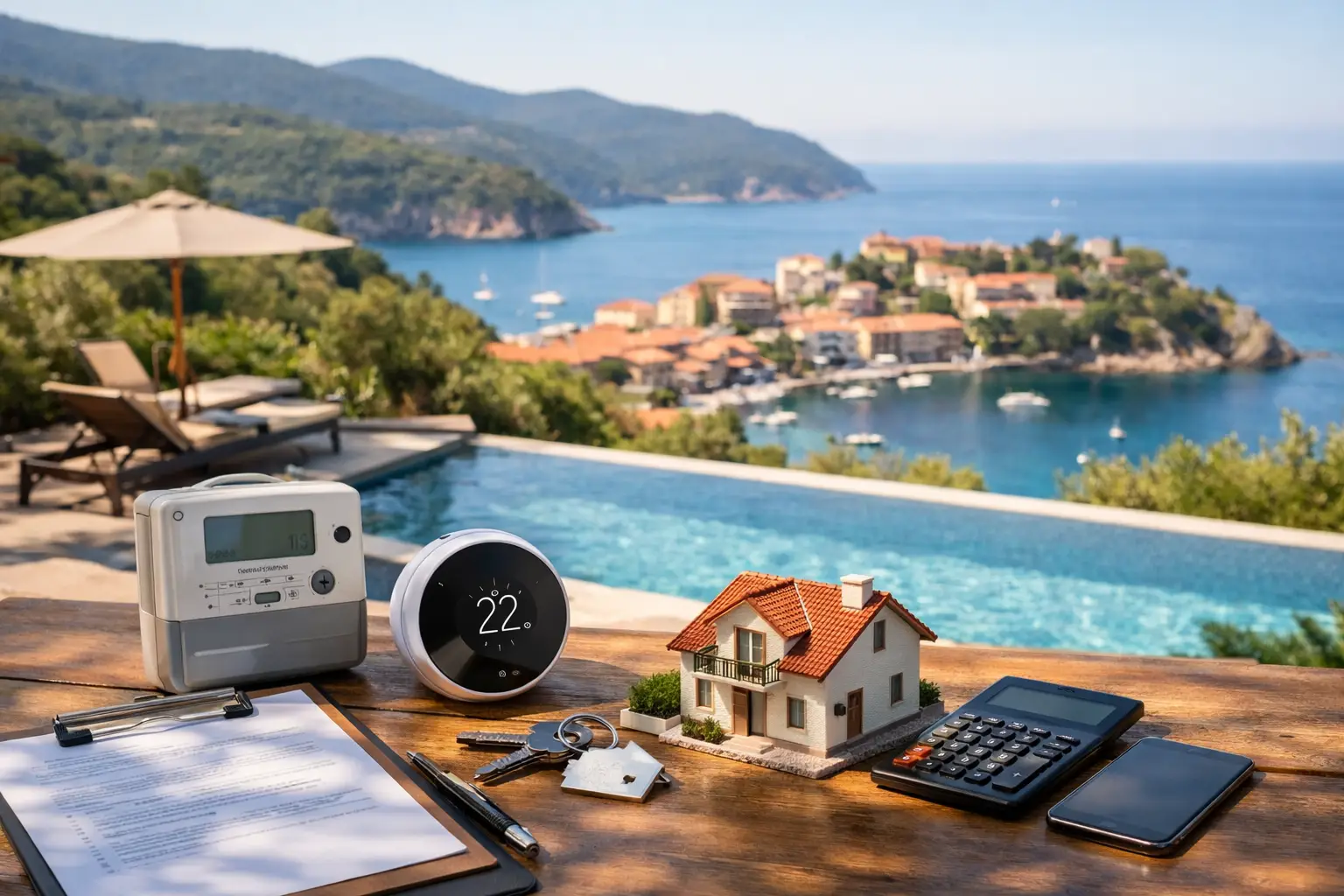
When a holiday home remains closed for weeks or months, silence isn't the only concern. Often, the real risk is invisible: a meter that keeps ticking, a slow leak, a tripped circuit breaker, or an appliance left running unnecessarily. Holiday home utilities monitoring is designed precisely for this—to prevent waste, identify anomalies in time, and protect a property that isn't lived in everyday.
For those who own a second home on Elba Island, this aspect holds tangible value. From a distance, an anomalous bill might arrive long after the damage has already begun. And when no one regularly enters the house, even a small fault can turn into a more costly problem than anticipated.
Why utilities monitoring in a holiday home should not be postponed
In a property used only during certain periods of the year, utilities are not a static element. Electricity, water, and gas continue to demand attention even when the house is empty. An electrical system can experience surges, a water line can have microleaks, or a boiler or water heater might remain active more than necessary.
The point isn't just to reduce consumption. Monitoring primarily serves to verify that everything is consistent with the property's actual state. If the house is closed, consumption should be compatible with minimal use. If not, there's a signal that needs further investigation.
This is even more crucial for holiday homes in Elba, where many properties remain uninhabited during the low season months. Prolonged absence makes it harder to notice an anomaly immediately, and every day lost can escalate the damage.
Which utilities require the most attention
Electricity is often the first point to check. A refrigerator left on, poorly set air conditioning, a faulty automation system, or a device in continuous standby can impact consumption more than one might think. In some cases, the problem isn't the cost itself, but the fact that abnormal absorption signals a malfunction.
Water is the utility that most often conceals the worst risks. A minimal leak in a bathroom, kitchen, or outdoor area can continue for weeks without giving obvious signs to someone far away. When the house is reopened, owners might face high bills, dampness, infiltrations, or damage to walls and furnishings.
Gas, where present, requires even more prudent monitoring. The issue isn't always a significant leak. Sometimes the critical point is simpler: a system left active unnecessarily, pressure to be checked, or an appliance that merits a visual inspection during control visits.
What a good holiday home utilities monitoring service includes
Effective monitoring isn't limited to reading a meter. It must connect the data to the actual condition of the house. If a property is closed and in order, consumption should be logical. If something seems off, an on-site check is necessary.
In practice, holiday home utilities monitoring should include visual inspection of accessible meters, comparison with expected consumption levels, inspection for indirect signs like dampness, drips, unusual odors, or tripped circuit breakers, and confirmation of the general state of the systems.
There's also an important difference between occasional and periodic checks. A one-off verification can be useful before the owners' arrival or after a long period of closure. But continuity makes all the difference. If visits are regular, it's easier to understand whether consumption is normal or not, because there's a benchmark over time for comparison.
Signals that should not be ignored
There are anomalies that deserve immediate attention, even if they seem minor. A bill higher than usual without a clear reason is the first warning sign. The same goes for a water meter that registers movement when the house is closed, or an electrical system that requires frequent resets.
The internal environment also offers useful clues. Damp patches, unusual condensation, a stronger-than-normal musty smell, or signs of dripping near sanitary fixtures and connections can indicate that the problem isn't just aesthetic. In an uninhabited house, these signs tend to worsen unnoticed.
Local monitoring is decisive precisely for this reason. From a distance, you see the bill. On-site, you understand the probable cause and can intervene quickly.
Utilities Monitoring for Your Holiday Home in Elba: Why Local Presence Matters Most
For an owner living off the island, the difficulty isn't understanding the importance of checks. The real difficulty is managing them consistently. Returning to Elba to verify suspicious anomalous consumption isn't always possible, and waiting until the next stay can mean leaving the problem unaddressed for months.
Here, local presence changes the level of protection. Having someone regularly check the property allows for verification that utilities are under control, that meters show consistent data, and that there are any signs requiring technical intervention. It's not a bureaucratic matter. It’s concrete protection of the property.
For many second homes in Portoferraio, Capoliveri, Porto Azzurro, Marina di Campo, or other areas of the island, seasonality emphasizes the need for periodic checks. The longer the closure period, the more useful a reliable presence becomes to observe, report, and document.
Reducing costs is useful, but the real goal is prevention
When talking about utilities, one immediately thinks of saving money. This is understandable, but it's not the main point. A lighter bill is an advantage. However, the greatest value of monitoring is to avoid more serious consequences: water damage, undetected faults, systems left in suboptimal conditions, or inconveniences just before the arrival of owners or guests.
This is especially true for homes that must always be ready for use. If the property is reopened for a weekend, for the summer, or for the arrival of family, finding a power outage or a plumbing issue at the last minute creates stress, delays, and additional costs. Checking beforehand means arriving with greater peace of mind.
Naturally, not all homes require the same level of attention. It depends on the size of the property, the presence of a garden or outdoor spaces, the type of systems installed, and the frequency of use. A villa with multiple bathrooms, a technical area, and irrigation will have different needs compared to an apartment used only in summer. But in both cases, the principle remains the same: an empty house is not a house without monitoring needs.
When to schedule checks
There isn't a single schedule for everyone, but certain phases of the year are particularly sensitive. Before the season of use, it's useful to check that everything is ready and that utilities are active and regular. After closing the house, it's advisable to verify that systems have been left in correct conditions. During longer periods of absence, programmed visits help intercept problems before they escalate.
Even after specific events, it may be appropriate to conduct a check. A severe storm, a power outage, a neighbor's report, or an unexpected bill are all cases where an on-site check can avoid uncertainties and wasted time.
A diligent service does not treat utilities as a mere formality. It considers them part of the overall surveillance of the house. This is the approach that makes monitoring truly useful for those who entrust their property remotely.
Monitoring that protects the home even when you're not there
For those who own a second home on Elba Island, utilities monitoring is a concrete form of guardianship. It means knowing whether the property is consuming what it should, whether systems are in order, and whether there are signs that require immediate attention.
There's no need to wait for obvious damage to intervene. Often, the difference between a protected house and an exposed house lies precisely in the regularity of checks. Elba Property Care operates with this logic: local presence, periodic verification, and practical attention to anything that could compromise safety, efficiency, and peace of mind.
When a house remains empty, it doesn't just need to be securely closed. It needs continuous monitoring, because even a meter can reveal a lot before the problem becomes visible.