Unoccupied House Surveillance: What You Need
Unoccupied house surveillance: how to protect a second home with regular checks, local prevention, and rapid interventions all year round.
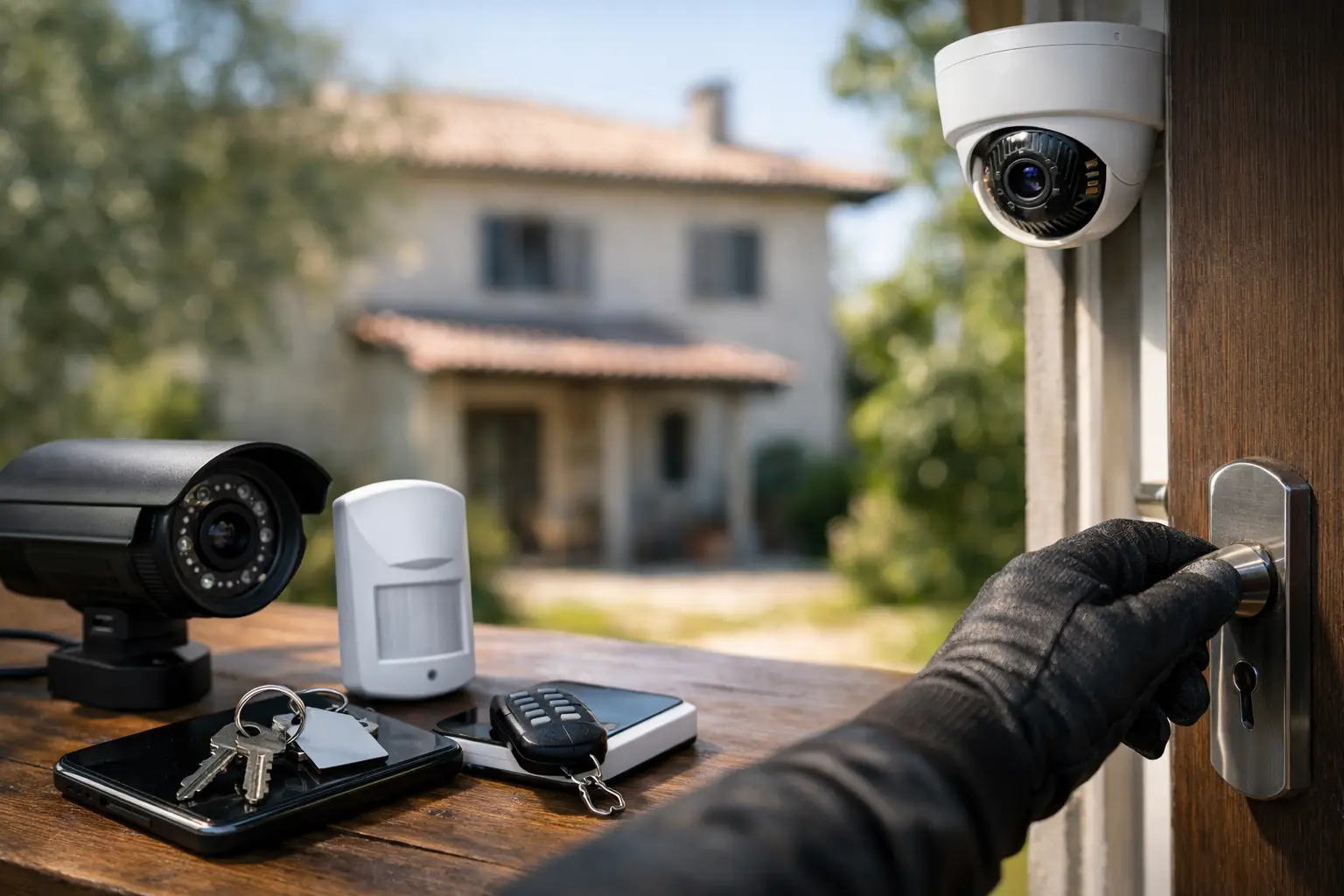
An empty house never truly sits still. Especially on an island, where saltiness, humidity, wind, long periods of closure, and the owners' absence can turn a small issue into costly damage. This is why unoccupied house surveillance isn't just about an alarm or a camera: it's a continuous activity of on-site control, prevention, and verification.
Anyone who owns a second home on Elba knows this well. The risk isn't just intrusion. Often, the most significant problems arise from what isn't immediately visible: a slow leak, a blackout that stops essential systems, infiltrations after a storm, frames damaged by the wind, musty odors, signs of dampness, or simply a property left too long without presence. From afar, even managing a small anomaly becomes complicated.
Why unoccupied house surveillance goes beyond security
When discussing surveillance of an unoccupied house, many initially think of burglar alarms. This is understandable, but limited. The true protection of an unoccupied property comes from combining security systems with the regular presence of a reliable person who checks the property's condition.
An alarm can signal unauthorized access. A camera can show an event. But neither of these tools, alone, can close a shutter blown open by the wind, notice a spreading damp patch, or verify if the meter, gate, or plumbing system are working correctly. Active oversight makes all the difference.
For an owner living out of the area or abroad, this aspect matters more than technology itself. What is truly needed is the assurance that the house is seen, verified, and monitored regularly, not just "surveilled" in an abstract sense.
The real risks of a vacant home
An unsupervised second home is more exposed to problems that often emerge too late. Some are obvious, others much less so.
There's the security aspect, of course, with potential access attempts or intrusions favored by long periods of absence. But there are also structural and management risks: water leaks, infiltrations, mold formation, weather damage, electrical faults, service interruptions, deterioration of outdoor spaces, full mailboxes, signs of neglect that make the house appear abandoned.
On Elba, the environmental context also comes into play. Proximity to the sea, sun exposure, humidity, and wind accelerate wear and tear. A property closed for months requires periodic attention precisely to remain in good condition between stays.
The point is not to panic. The point is to prevent a problem from remaining invisible until the owners return.
Unoccupied house surveillance: what checks truly make a difference
Effective unoccupied house surveillance relies on scheduled checks. The keyword is regularity. There's no need to intervene only when there's an emergency. It's about noticing issues before they become emergencies.
A well-executed check includes verifying access points, the condition of doors, windows, shutters, gates, and fences. It also includes an internal visual inspection, when scheduled, to detect dampness, unusual odors, signs of infiltration, issues with systems, or minor damages that can worsen over time.
Outdoor spaces also matter. Gardens, terraces, entrance areas, and parts exposed to the elements often provide the first signs of critical issues. A well-maintained and regularly visited property conveys presence. A neglected property communicates the opposite.
This is why a serious service doesn't just "drive by." It must verify, record, report, and, when necessary, act quickly.
Technology, yes, but not enough on its own
Cameras, sensors, and alarm systems are useful. In many cases, they are advisable, especially to increase the ability to detect anomalous events in real-time. However, technology works best when integrated into a broader supervision system.
If an alarm goes off while the owner is in another city or country, who goes to check? If a camera shows a shutter open after a strong gust of wind, who intervenes? If the power goes out and devices stop communicating, who notices on-site?
Herein lies the practical limit of remote systems. They offer visibility, but they don't replace local presence. For a second home, the most reliable model is mixed: security tools plus periodic physical checks, with a reference person who knows the property and can intervene without delay.
The value of local presence
For those who don't live permanently on Elba, true peace of mind doesn't come from receiving a notification on their phone. It comes from knowing that there's a local contact person who continuously checks the house and knows how to act if something goes wrong.
Local presence reduces reaction times and improves decision quality. A professional who knows the property, the area, and the island's seasonality can more easily distinguish a false alarm from a real problem. And above all, they can coordinate necessary actions before damage escalates.
This approach is particularly useful for foreign owners, families who use the house only during certain months of the year, or investors who cannot remotely monitor every operational detail. In these cases, the service is not just a simple check: it's continuous oversight.
How to choose a surveillance service for a second home
Not all services are equal. Some offer only on-call interventions, others build a program of regular checks. The difference is substantial.
If the goal is to truly protect an unoccupied house, it's advisable to look for a service that operates preventively, with defined frequency, clear reports, and availability to manage anomalies or emergencies. Prevention costs less than restoration, but it requires method.
It's also worth considering knowledge of the local context. A second home by the sea has different needs than an apartment inhabited all year round. Attention to environmental conditions, the ability to read signs of deterioration, and an organization that doesn't solely depend on reacting to an already occurred event are needed.
Another decisive aspect is trust. Those who entrust a property remotely are not just looking for technical execution. They seek discretion, reliability, and timely communication. In practice, a presence that protects the house as if it were never left alone.
Prevention, costs, and property value
Sometimes surveillance is viewed as an optional expense. In reality, for a sporadically used house, it is a concrete form of protecting the property's value.
A regularly checked property tends to better preserve its structure, systems, and overall appearance. This impacts comfort upon return, but also future expenses. Intervening on a small infiltration or an initial fault is very different from having to manage extensive damage after months of absence.
Then there's a less visible but very real benefit: stress reduction. For many owners, the greatest burden isn't just financial. It's uncertainty. Not knowing the house's condition, having to manage unforeseen events from afar, coordinating suppliers without an on-site presence. Good surveillance eliminates much of this pressure.
When the house is truly ready to be left vacant
A house is not protected just because it was well secured last time. It is protected when a control system is in place throughout the entire absence. This is even more true for properties used seasonally.
Before leaving the property for weeks or months, it's useful to have a clear plan. Not just passive security, but also inspections, system checks, exterior control, and a precise procedure in case of anomalies. It is this organization that transforms absence into calm management, rather than an unknown.
In a territory like the Island of Elba, where many homes are lived in at alternate periods, a well-structured home-watching service responds precisely to this need. Elba Property Care operates with this logic: constant presence, scheduled checks, and practical attention to everything that can compromise the owner's security, efficiency, and peace of mind.
Unoccupied house surveillance truly works when it doesn't just react. It must observe, prevent, and intervene continuously. Because a second home adds value to leisure time only if, when the door is reopened, it is found exactly as it should be: secure, in order, and under control.