How to Prevent Break-ins at Your Second Home on Elba Island
How to prevent break-ins at your second home on Elba Island: regular checks, lighting, secure access, and local supervision to protect your property year-round.
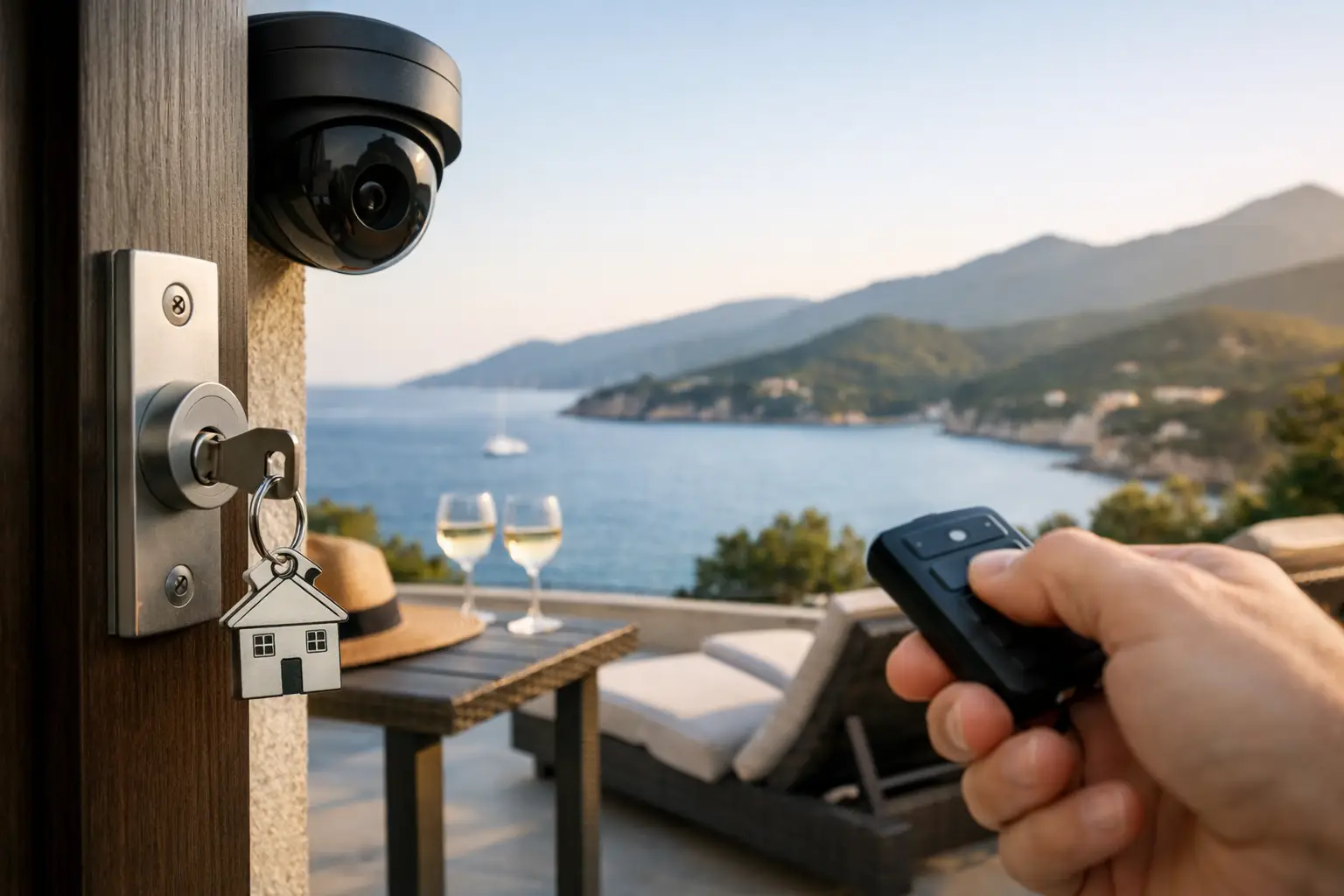
A second home left vacant for weeks or months sends very clear signals to anyone who knows how to observe: shutters always closed, mailboxes overflowing, no movement, no evening lights. When asking how to prevent break-ins at a second home on Elba, the point isn't just to install a better lock. The real issue is making the property visibly attended, controlled, and less predictable.
On Elba Island, many homes remain empty during the off-season or between stays. For owners living elsewhere, in Italy or abroad, the risk arises not only from absence but from the lack of a reliable local presence. A home left unsupervised for too long becomes more exposed, not because it's isolated, but because it appears forgotten.
How to realistically prevent break-ins at your second home on Elba
Effective prevention starts with an honest assessment of the home. A secluded villa above Capoliveri has different vulnerabilities than an apartment in Portoferraio or a holiday home in Marina di Campo. Access points, visibility from the street, proximity to neighbors, traffic, and ease of control all change.
For this reason, there's no single solution. However, some principles almost always work. The first is to reduce signs of abandonment. The second is to increase the time, noise, or uncertainty for anyone attempting entry. The third, often overlooked, is to make it clear that someone truly monitors the property continuously.
A protected home isn't necessarily the most technologically advanced. It's one where a potential intruder cannot figure out if the owner is absent, when they will return, or who will notice an anomaly.
The most common weaknesses in second homes on Elba
Many break-ins occur by exploiting simple elements: outdated fixtures, gates left unchanged for years, keys stored in obvious places, insufficient outdoor lighting, vegetation covering entrances and windows. Even a damaged shutter or an unchecked fence can communicate a lack of attention.
Another common mistake is thinking that an alarm is enough. An alarm helps, but it doesn't solve everything on its own. If it goes off in an empty house and no one quickly checks what happened, its effect is reduced. The same applies to cameras: they are useful, but more so when they are part of a real monitoring system, and not just passive recording.
Then there's the habit factor. If the property always remains completely dark, always closed in the same way, always without any signs of activity, it becomes readable. Predictability is one of the biggest advantages for those seeking an easy target.
Secondary accesses and less visible areas
In second homes, attention often focuses on the main door, while the most vulnerable access points are elsewhere: back patio doors, low windows, garages, utility rooms, side entrances, secondary gates. In independent properties, these areas deserve the same level of scrutiny as the main entrance, sometimes even more.
Outdoor spaces also matter. An overly dense garden provides cover. A dimly lit driveway reduces visibility. An isolated house, if not monitored, requires stricter measures than a property located in a year-round inhabited area.
Practical measures that truly make a difference
The first sensible investment concerns physical security. Updated locks, reliable closing points, well-maintained fixtures, and periodically checked gates immediately raise the level of protection. There's no need to turn the house into a fortress, but to eliminate the easiest weaknesses to exploit.
Immediately after comes visible management. Outdoor lights with sensors, programmed indoor lighting, and small signs of activity make the house less readable. The goal isn't to theatrically simulate a continuous presence, but to avoid the effect of a stagnant, dark property.
Even routine maintenance plays a direct role in security. Collecting mail or flyers, checking gates and fences, verifying no signs of forced entry, managing greenery, and ensuring that nothing communicates neglect are simple but decisive actions. A well-maintained property deters more than many owners imagine.
Alarm, cameras, and on-site control
Technology is useful when integrated into a verification routine. A well-configured alarm system can deter or quickly signal a problem. Cameras help monitor access and the perimeter. But the real value increases when, after a notification or during scheduled checks, someone can go on-site and verify.
For those who don't live on the island, this is precisely the crux. Receiving a notification on your phone while you're away isn't equivalent to a concrete response. If the house is on Elba, the difference is made by local supervision capable of regularly checking the property and intervening in a reasonable time when something is amiss.
Local presence is a form of deterrence
Second home owners tend to think of security as a set of devices. In reality, the continuity of checks is often the factor that changes the risk. A house periodically visited, carefully inspected, and kept tidy appears to be looked after. This reduces the sense of impunity that favors intrusion attempts.
On Elba, this aspect has particular weight because many properties are not permanently occupied year-round. During less frequented periods, knowing that the property is regularly checked offers concrete, not just psychological, protection. It means being able to intercept small but important signals in advance: an open gate, a moved shutter, footprints, misplaced objects, attempted entries, or damage that makes the house more vulnerable.
A local home watching service does not replace doors, windows, or an alarm, but makes them more effective. Security works better when there is someone observing, verifying, and tracking the situation over time. For an absent owner, this continuity is as valuable as the installed hardware.
How to organize credible year-round protection
Prevention should not only be activated before summer or after a suspicious incident. A second home must be protected with care in every season. The most critical periods are not the same for everyone: they depend on the house's location, frequency of use, and the surrounding context.
For some properties, a regular plan of periodic checks, combined with good lighting and reliable closures, is sufficient. For others, especially if isolated or with large outdoor spaces, a higher level of attention is needed. This is where it's advisable to think in terms of concrete scenarios rather than standard formulas.
If the house remains empty for a long time, it is useful to plan scheduled checks, access control, perimeter observation, and management of obvious signs of absence. If, however, it is used occasionally but often, the critical point is to maintain continuity between stays, without leaving excessively long time windows during which the property seems out of control.
Mistakes to avoid
The most common is procrastination. Many owners only intervene after an attempted break-in or after noticing something abnormal. But second home security works better as prevention, not reaction.
Another mistake is relying on partial solutions. A good door without periodic checks, or a camera without local verification, can give a false sense of security. Also, leaving valuables clearly visible or storing emergency keys in intuitive spots remains a carelessness to be corrected immediately.
Finally, there is the underestimation of the context. Not all properties on the island have the same risk profile. A serious assessment must consider location, accessibility, exposure, the house's history, and actual periods of absence.
How to prevent break-ins at your second home on Elba with a continuous approach
If the goal is to truly protect the property, the right question is not what single system to install, but how to build a credible presence even when the owner is away. In this sense, prevention means combining physical security, visible order, periodic control, and on-the-ground response capability.
For many second homes on Elba, the most effective solution is not extreme, but constant. A property regularly checked, well-maintained, and overseen by a reliable local contact person becomes harder to read, more inconvenient to target, and simpler to protect over time.
This is the type of security that gives peace of mind to those who live far away: not the promise that nothing will ever happen, but the certainty that the house will not be left alone, unattended, precisely when it needs attention most. On an island like Elba, this continuity often makes the difference between a closed house and a truly safeguarded one.