Moisture control in a seaside home: what to do
Moisture control in a seaside home: how to prevent mold, condensation, and damage in second homes on Elba Island with regular checks and targeted interventions.
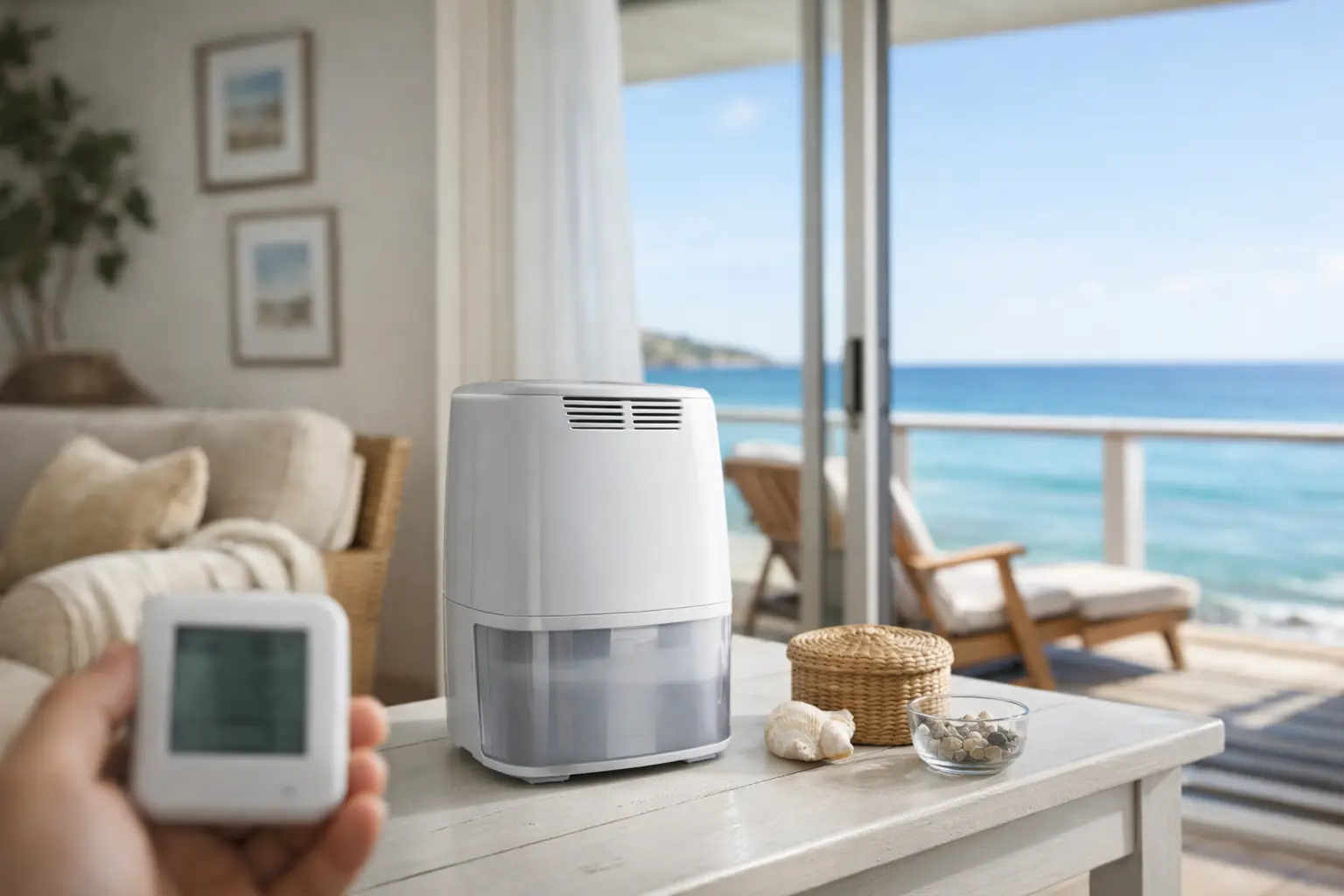
Just leave a house closed for a few weeks, especially near the sea, to return and find a musty smell, stains on the walls, damp wardrobes, and fabrics heavy with salty air. Moisture control in a seaside home is not a seasonal detail: it's a concrete form of property protection, particularly important for those who own a second home on Elba Island and cannot continuously check on it.
Humidity in coastal homes rarely stems from a single cause. It's often the combined effect of sea air, poor ventilation, long periods of closure, and neglected minor issues, such as a worn gasket or a window that doesn't seal properly. The critical point is this: when the house remains empty, an initial discomfort can turn into real damage before the owner even notices.
Why moisture control in a seaside home requires more attention
A seaside home experiences different conditions compared to an inland property. The air contains more humidity, saltiness deposits on surfaces, day and night temperature swings promote condensation, and closed environments retain everything for longer. In Elba locations like Portoferraio, Capoliveri, or Marina di Campo, exposure to wind, the house's orientation, and distance from the sea make a big difference, but the risk never completely disappears.
The problem isn't just with the walls. Humidity also affects fixtures, furniture, mattresses, curtains, electrical systems, and metal surfaces. Initially, you might notice a persistent smell or a stain in a corner. Over time, mold, swelling, deterioration of finishes, and a general decline in the quality of the indoor environment can appear.
This is why control should not be limited to a quick visual check. It requires regular attention, consisting of observation, prevention, and timely interventions when something changes.
Signs not to underestimate
Those who use the house only during certain periods of the year tend to notice the more obvious signs, but often the first clues are more discrete. A wardrobe that smells damp, sheets cold to the touch, a slightly darker wall, drops on the windows in the morning, or peeling paint near windows and ceilings are warning signs.
Even details matter. If doors are hard to open, if wood seems swollen, if black spots appear behind furniture, or if towels left in the house never truly dry, humidity is already stably present. In second homes, this is the biggest risk: no one sees the problem evolve day by day.
In a property not continuously inhabited, waiting for the next stay to check can mean arriving too late. A small seasonal condensation issue is manageable. Extensive mold or an ignored infiltration for months, however, requires significant costs, time, and more extensive work.
Where humidity truly comes from
Not all humidity is the same, and understanding its origin completely changes the solution. In a seaside home, three situations are often encountered.
The first is condensation, caused by the meeting of humid air and colder surfaces. It's common in poorly ventilated rooms, bathrooms, long-closed bedrooms, and corners behind furniture pushed against walls.
The second is infiltration humidity. This can stem from terraces, roofs, windows and doors, micro-cracks in facades, or critical points around doors and windows. Near the sea, wind and driving rain stress even elements that seem in good condition.
The third is rising damp or structural humidity. It is not the most common cause in every property, but in some houses, it can be significant, especially if they are ground floors, basements, or constructions with pre-existing issues.
Realism is needed here: opening windows for a few hours doesn't solve everything. In some cases it helps, in others it's insufficient, and sometimes with high external humidity, it can even worsen the situation. This is why control must be practical, not automatic.
What to do when the house remains empty for weeks or months
For a second home on Elba, the most delicate phase is not when the property is being lived in, but when it remains closed. During that period, air stagnates, small defects remain unnoticed, and humidity has time to accumulate.
The first useful measure is to avoid total closure without any intermediate checks. An unoccupied house needs periodic on-site checks, especially during damper months or after intense weather events. Checking windows, shutters, signs of condensation, unusual odors, and the condition of the walls allows problems to be intercepted before they escalate.
Internal arrangement also matters. Furniture too close to external walls, fabrics left compressed in wardrobes, mattresses resting without air circulation, and completely sealed rooms all promote stagnation. Large interventions are not always necessary: often practical choices reduce the risk.
The use of dehumidification or controlled ventilation should also be considered, but without thinking that there's a single valid solution for every property. A small south-facing apartment has different needs than a villa in a windy location or a house with a more fragile ground floor. The correct principle is this: first observe the house's behavior, then decide how to intervene.
Moisture control in a seaside home: concrete prevention
Effective prevention is not based on a single action, but on continuity and method. A seaside home should be looked after as an asset to be protected over time, not just to be reopened before summer.
Regular checks allow specific points to be controlled: cold corners, behind furniture, frames, ceilings, bathrooms, kitchens, utility rooms, and less-used areas. If a change is detected during a visit compared to the previous one, action can be taken early. This is even more true for homes that remain uninhabited out of season.
It's also useful to monitor the condition of fixtures and closures. A window or door that lets in air and water, a damaged roller shutter, or a shutter that isn't perfectly aligned can become the source of internal humidity. In coastal areas, wear accelerates and requires constant attention.
Anti-mold paint can be a support, but it should not be confused with a definitive solution. If the cause remains active, the problem will return. The same applies to portable dehumidifiers: they work in certain conditions, but without periodic checks, they are not enough to protect an empty house for long periods.
Why local control makes a difference for a second home on Elba
When the owner lives elsewhere, the real problem is not just humidity itself. It's the time that passes between the problem's onset and when someone sees it. In a primary home, a stain, an odor, or a window that condensates too much is noticed almost immediately. In a second home, that margin of reaction often doesn't exist.
This is why local presence has concrete value. Those who carry out scheduled checks on Elba Island can detect minimal alterations, verify if there has been an infiltration after bad weather, check the condition of internal environments, and take action before humidity compromises walls, furniture, or systems.
It's not just about "taking a look." A well-executed check compares the situation over time, observes the property's vulnerable points, and distinguishes between a temporary episode and a problem that is becoming structural. It is this continuity that offers peace of mind to absent owners.
For a holiday home or a villa used only at certain times of the year, protection comes from here: local presence, regularity, and the ability to intervene early. This is the approach with which companies like Elba Property Care help owners keep their property under control even when they are not physically present.
When to intervene immediately
If the musty smell rapidly increases, if new stains appear, if mold spreads to multiple rooms, or if signs are noticed near ceilings, fixtures, or exposed walls, it's not advisable to wait. The same applies after heavy rains, storm surges, or long periods of closure without inspections.
Waiting almost always costs more than timely control. Not just financially, but also practically: a house that was supposed to be ready for use might require cleaning, drying, restoration, and technical time precisely when the owner is about to arrive.
Protecting a seaside home means anticipating, not chasing. And on Elba, where many properties remain empty for part of the year, humidity control is not an accessory intervention: it is one of the most useful checks for preserving the house's value and finding it, every time, in the right condition.