How to Secure Your Villa on Elba Island
Discover how to secure your villa on Elba with regular checks, prevention, and local presence to protect your home year-round.
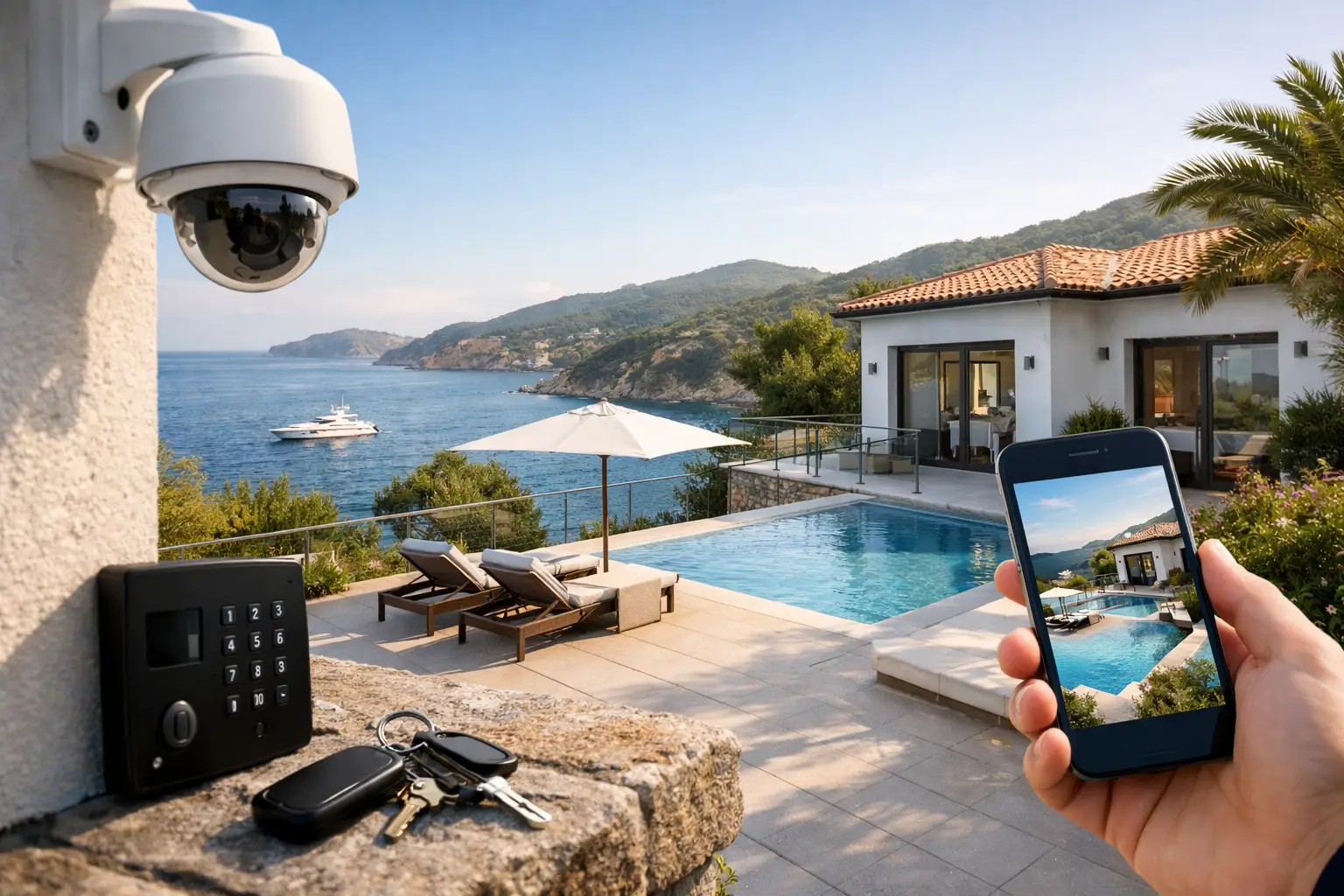
A villa closed for weeks or months doesn't simply stand still. On Elba Island, it remains exposed to salt spray, humidity, wind, storms, minor malfunctions, and unwanted access. That's why understanding how to secure your villa on Elba means going beyond alarms and locks: it requires constant, local, and organized oversight.
What does it really mean to secure a villa on Elba?
When people talk about security, many owners immediately think of intrusion. This is a real concern, but it's not the only one. An unoccupied villa can suffer damage even without any forced entry: a water leak discovered late, a blackout that stops essential systems, accumulating humidity, window frames stressed by the wind, neglected outdoor areas that make the property more vulnerable and visible.
On Elba, this aspect is even more significant for those who live far away and only visit their home during certain times of the year. Distance prolongs reaction times. A small problem, if no one sees it immediately, can become costly. Securing a villa therefore means reducing risks before they turn into emergencies.
How to concretely secure your villa on Elba
The most effective approach is not based on a single measure. It works when physical security, periodic checks, and local supervision work together. This is where many owners make the most common mistake: they install a system and think they've solved everything. In reality, a system without on-site verification only covers a portion of the problem.
The first level: closures, access points, and vulnerable spots
The foundation always remains good protection of access points. Doors, windows, shutters, gates, and secondary entrances must be carefully checked. It's not enough for them to be present; they must be in good condition and genuinely reliable. A worn lock, a shutter that doesn't close properly, or a window frame exposed to the sea and never checked become weak points.
It's also worth checking less obvious access points, such as utility rooms, garages, external storage, and service entrances. In independent properties, often, the main entrance is not the most critical point. Security starts with a complete perimeter check.
The second level: alarm and video surveillance, but with discretion
An alarm is useful, and well-positioned video surveillance is too. But their effectiveness depends on how they are managed. If an alarm goes off while the owner is abroad or away from the island, who actually responds? If a camera signals an anomaly, who verifies on-site whether it's a false alarm or a real problem?
For a second home on Elba, technology helps greatly but doesn't replace local presence. This is the crucial point. An electronic system is more effective when it's supported by someone who can check the property, confirm the situation, and quickly activate necessary actions.
The third level: scheduled periodic checks
Much of the real security lies here. Periodic visits allow verification that everything is in order even when the villa is empty. Checks include closures, signs of unusual access, systems, any infiltrations, internal and external conditions, presence of humidity or suspicious odors, and the state of the garden and areas visible from outside.
A regularly checked property is less exposed for two reasons. The first is practical: problems are intercepted early. The second is deterrent: a house that shows care and continuity is less vulnerable than a property clearly left to its own devices.
Common risks in unattended villas on Elba Island
Every property has its own characteristics, but some risks are common. Homes near the sea may suffer more from the effects of salt spray on window frames, locks, and external components. Villas surrounded by greenery require more attention to perimeter access, vegetation, gates, and less visible areas. Properties used only in summer remain for long periods without direct owner oversight.
Added to these elements are silent failures. A minimal leak can go unnoticed until it causes serious damage. An electrical outage can compromise systems and devices. A severe storm can leave traces that are not visible remotely. Not everything makes noise, not everything triggers an alarm, not everything can wait for the owners to return.
External security and perception of the home
Securing a villa on Elba also means managing the external perception of the property. A house with overgrown vegetation, visible clutter, signs of absence, or neglected areas communicates abandonment. Conversely, a tidy, controlled, and visibly cared-for villa conveys a sense of presence.
This is not strictly about aesthetics. It's about prevention. Security also comes down to simple details: clear access, working gates, checked outdoor lighting, well-maintained mailboxes or delivery points, and regularly inspected sensitive areas. These are signals that reduce the impression of vulnerability.
Why distance changes everything
Many owners already have useful tools: cameras, sensors, home automation, phone notifications. The limitation arises when the villa is on Elba and the owner is elsewhere. At that moment, the question is no longer just what happened, but who can go and check immediately.
This is where security takes on a concrete form. Having a local contact means not having to improvise in case of a report, bad weather, post-event checks, or simple doubts about the state of the house. Peace of mind doesn't come from technology alone, but from the certainty that someone can provide continuous intervention.
How to secure your villa on Elba without excessive, useless spending
Not all villas need the same level of protection. A property used intermittently but in a well-frequented area has different needs than an isolated villa or one with extensive outdoor spaces. The period of disuse also matters: leaving the house empty for two weeks is not the same as leaving it closed for four months.
For this reason, it's advisable to avoid both the minimal and the oversized approach. Spending a lot on systems and then not having periodic checks can be less effective than a more balanced strategy. The best solution comes from a practical evaluation: the villa's location, exposure to external agents, ease of access, duration of absence, presence of sensitive systems, and need for local support.
The value of continuous local monitoring
For a second home, true security is continuity. It's not enough to intervene when something happens. A monitoring system is needed that reduces the time to discover problems and keeps the property under observation throughout the year.
A local home watching service addresses exactly this need. Scheduled inspections, preventive checks, and the presence of a local contact on the island make the house less exposed and more manageable even from a distance. For those who do not live permanently on Elba, this means having a concrete presence between stays.
In the case of Elba Property Care, the value lies precisely in this approach: constant attention, on-site checks, and dedicated support for properties located exclusively on Elba Island. It's a model designed for those who need real protection, not just theoretical control.
Where to start if the villa remains empty for long periods
The first step is simple: look at the property as if no one were to enter for weeks. From there, priorities immediately emerge. Closures, essential systems, outdoor areas, less visible spots, signs of neglect, and response times in case of anomalies.
Immediately after, it's advisable to define a checking routine. Security works when it's regular. An occasional check might provide reassurance for a few days, but it doesn't replace organized monitoring. The repetition of checks makes the difference, especially during seasons when the villa remains unused for longer periods.
Protecting a villa on Elba doesn't mean living with worry. It means knowing that your home continues to be looked after even when you're not there, with the same attention you would give it in person.