Guide for Second Home Owners on Elba Island
Guide for second home owners on Elba Island: checks, risks, and best practices to protect your home all year round when you're not living on the island.
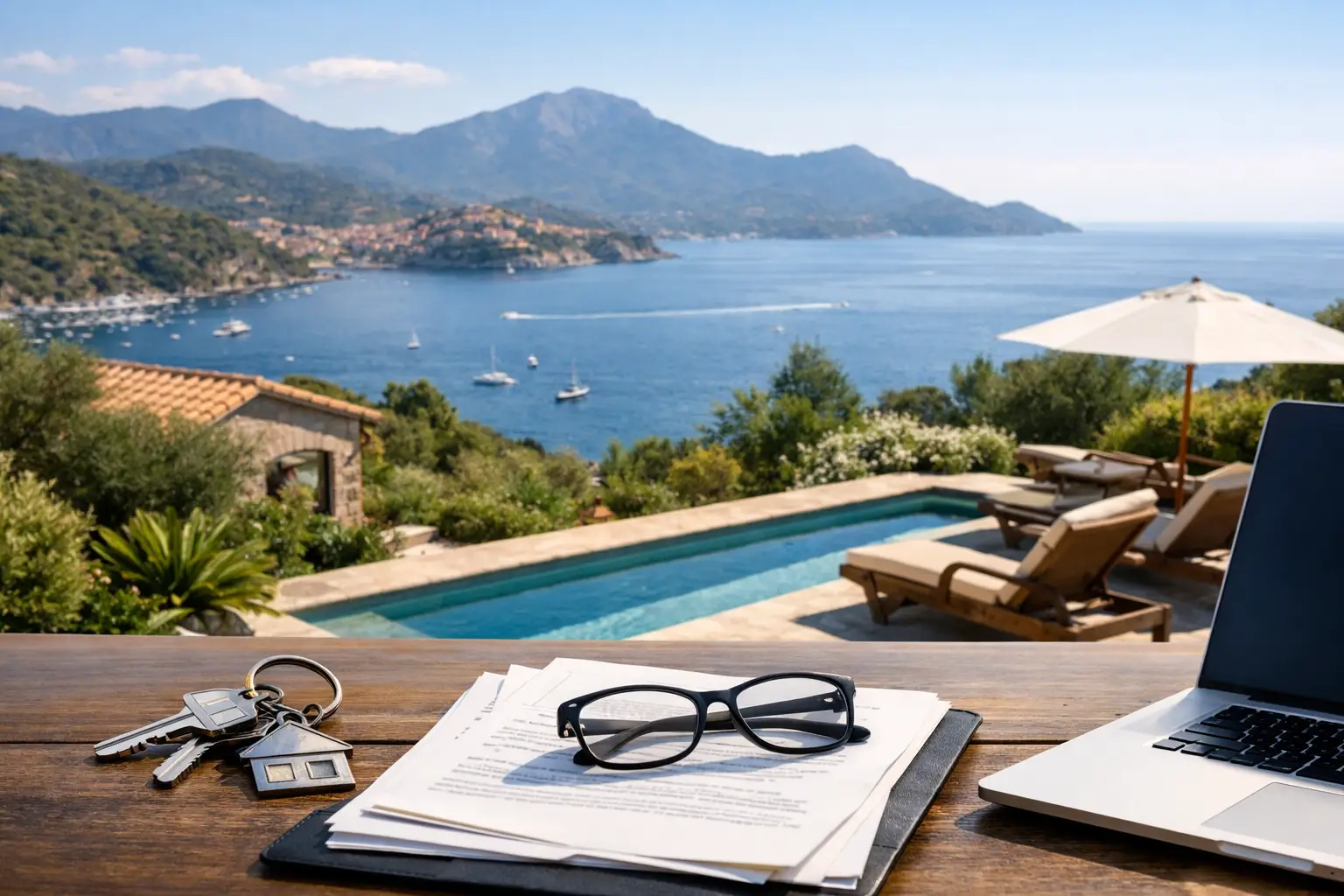
A house left closed for weeks, or even months, never truly stays still. On Elba Island, salt, humidity, wind, storms, minor faults, and the lack of regular checks can transform a negligible detail into a concrete problem. This guide for second home owners on Elba was born precisely from this: to provide a clear framework for those who own a home on the island but cannot be present continuously.
Anyone with a second home in Portoferraio, Capoliveri, Porto Azzurro, Marciana Marina, or Marina di Campo knows the feeling well. From afar, everything seems fine until a leak emerges, a damaged shutter, a meter signaling an anomaly, or a garden that, in a short time, changes the appearance and functionality of the property. The point is not just to intervene when there's damage. The point is to notice it beforehand.
Guide for second home owners on Elba: what truly needs protection
The most common risk isn't an exceptional event. More often, it's small, progressive problems that create the most expensive damages. A minimal leak under a sink, if no one enters the house for weeks, can compromise furniture, walls, and floors. A poorly closed window after a strong wind can let water in. A blackout or an electrical malfunction doesn't always resolve itself.
On Elba, there's also an environmental factor that weighs more than elsewhere. Homes near the sea or exposed to currents require constant attention. The climate, which makes the island so pleasant to live on, can also accelerate wear, corrosion, and deterioration of exteriors. This doesn't mean every property is fragile. It means an unsupervised property needs regular and realistic checks.
Location also plays a role. An apartment in an urban center and a more isolated villa have different vulnerabilities. In the first case, systems, access points, and neighbors are very important. In the second, gates, outdoor areas, vegetation, exposure to weather conditions, and reaction times in case of critical issues become central. There isn't a one-size-fits-all solution.
Distance is the real problem, not just maintenance
Many owners think of a second home in terms of ordinary maintenance. In reality, when living far away, the main issue is the lack of local oversight. If you're in Milan, Rome, or abroad, even a simple problem becomes complex because there's no reliable presence to verify, confirm, and coordinate.
Distance creates three specific difficulties. The first is uncertainty: not knowing if the house is truly in order. The second is time: organizing an urgent check remotely is never immediate. The third is trust: finding someone who will enter the property, observe carefully, and report what truly matters.
This is why the value of a local service isn't just about performing an inspection. It's about being a stable point of reference, capable of continuously checking the property and distinguishing what can wait from what requires rapid action. Protecting a second home depends on this continuity, not on occasional intervention.
What a serious check should include
An effective check is not a quick visit to verify that the door is closed. It must be methodical. It's necessary to check access points, fixtures, signs of infiltration, visible systems, internal conditions, unusual odors, presence of humidity, condition of external areas, and everything that could indicate an incipient problem.
In homes that remain empty for long periods, ventilation and general environmental checks also make a difference. A property closed for too long can develop conditions that, without being immediately serious, worsen rapidly. The same applies to exteriors: a clogged gutter, a fallen branch, a gate that doesn't close properly, or signs of wear after adverse weather deserve attention before the next season arrives.
A serious check must also provide clarity. The owner needs to know what has been verified, if there are anomalies, and what their priority is. True peace of mind does not come from a generic message. It comes from an organized presence, with regular checks and simple, precise, and timely communication.
Frequency of checks: depends on the use of the house
Not all second homes on Elba require the same frequency of supervision. A house used often throughout the year, in a populated context and with recent systems, may have different needs compared to a property opened only in summer or located in a more exposed area.
The period also matters. In the winter months or during long absences, checks become more valuable. After episodes of intense rain, strong wind, or long periods of closure, an extra check can prevent more serious consequences. The right rule is not to do checks "often" in the abstract. It's to do them with a frequency consistent with the actual risks of the property.
Common mistakes of absent owners
The most common mistake is thinking that the absence of signals equates to the absence of problems. If no one enters the house, many faults remain invisible. When they emerge, the damage is already advanced.
Another mistake is relying on occasional and informal checks. The helpful neighbor or the acquaintance who passes by occasionally can be a help, but they do not replace a responsible and continuous presence. Not for lack of goodwill, but because there is no method. Whoever checks a second home must know what to observe, with what regularity, and how to report critical issues.
There is also a frequent underestimation of outdoor areas. Gardens, terraces, roofs, driveways, and pedestrian access points affect the security and general condition of the property as much as the interiors. Neglecting them often means realizing late about wear, weather damage, or practical problems that make the house less ready for use.
When DIY is no longer enough
Managing everything yourself only makes sense as long as the level of control remains real. If it takes hours to get to Elba, if the property remains empty for long periods, or if every unforeseen event requires phone calls, checks, and remote coordination, DIY stops being an efficient solution.
It's not a matter of convenience. It's a matter of risk reduction. A careful owner doesn’t wait for damage to happen before organizing. They first establish a reliable local presence, capable of observing, intervening, and keeping the house under control throughout the year.
How to choose a local point of contact on Elba Island
The choice should not be based solely on willingness to perform an inspection. A presence that works in a structured way and with constant attention to the house as an asset to protect is needed. Whoever oversees an unoccupied property must know the territory, the island’s rhythms, the most common critical issues, and the value of timeliness.
The approach also matters greatly. A good local contact person neither minimizes nor unnecessarily alarms. They assess, verify, and communicate with balance. This aspect is essential for those who live far away, because every report should help in decision-making, not increase uncertainty.
For second homes on Elba, the most useful service is one that combines vigilance, continuity, and practicality. Not a passive presence, but a safeguard that protects the property when the owner is not there. In this sense, specialized entities like Elba Property Care address a precise need: to offer constant local control to those who want to know that their home is observed, verified, and carefully followed.
Guide for second home owners on Elba: the value of a ready home, not just a guarded one
Protecting a second home doesn't just mean avoiding damage. It also means keeping it ready. When you arrive on the island, the house should convey order, reliability, and continuous care. This is what truly makes returning serene, whether for a weekend or a longer stay.
A regularly checked property tends to better preserve its value over time. But above all, it reduces that invisible effort many owners know well: arriving on Elba and having to start their stay by solving problems. The second home should be a place to live in, not a list of urgent checks.
The most prudent choice, often, is not to wait for something to happen. It is to ensure that someone looks after the house with the same attention you would, even when you are far away. For a second home on Elba, true peace of mind begins exactly there.