Elba Property Ventilation: Combating Humidity and Mold
Elba property ventilation: checks against humidity, mold, and stale air to protect your second home during any prolonged absence on Elba.
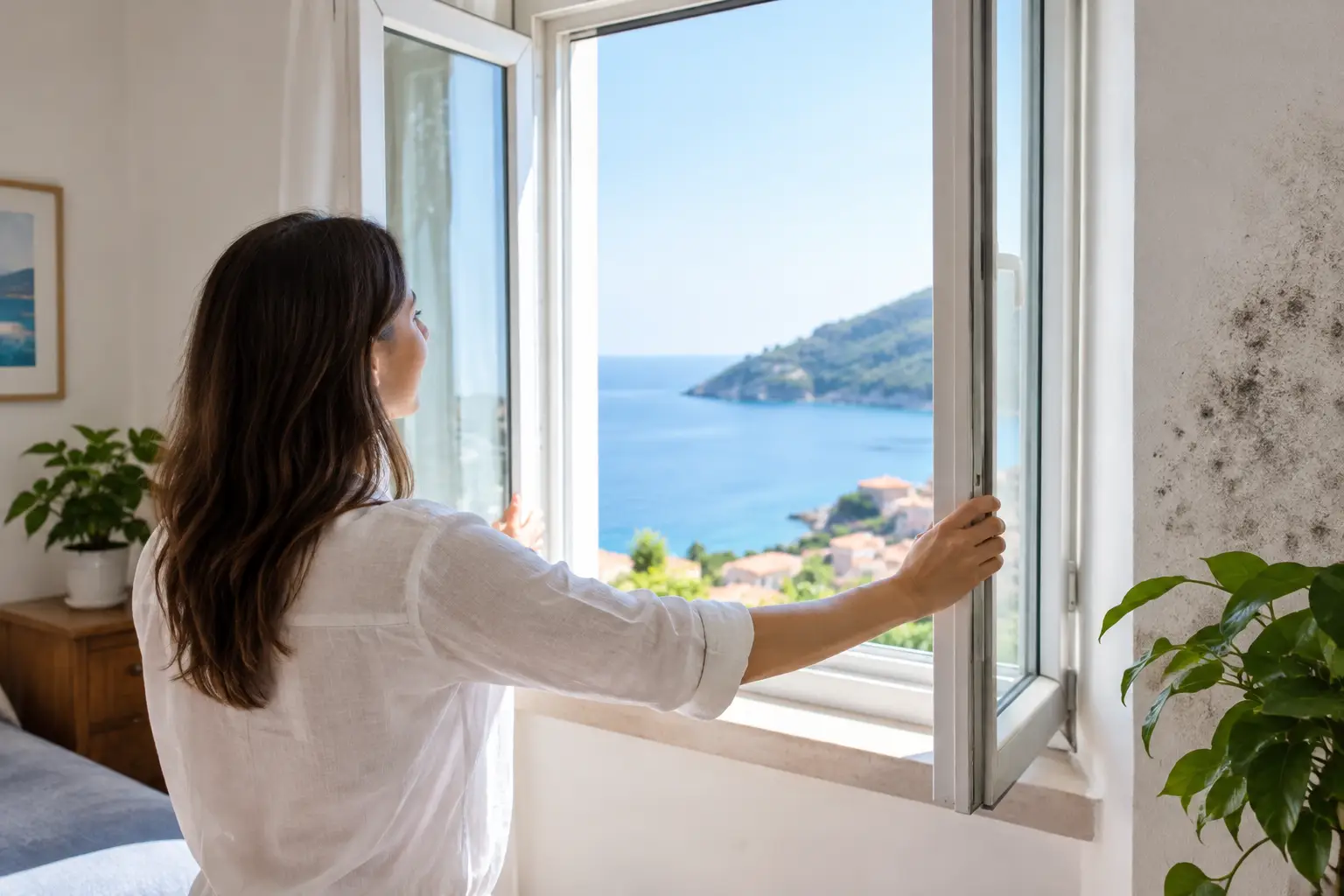
A house left closed for weeks might seem perfectly protected, but stagnant air often tells a different story. Elba property ventilation is a concrete preventive measure for second homes, villas, and seasonal residences: it limits condensation, odors, humidity, and the risk of small signs escalating into more complex damages upon your return.
On Elba Island, proximity to the sea, periods of high humidity, and owners' long absences make this control particularly useful. Simply opening windows isn't always enough. It needs to be done regularly, observing how the property reacts and intervening when the environment indicates a critical issue.
Why a Closed House Needs to Breathe
When a property remains unused, the humidity in the air doesn't just disappear. It can accumulate in areas less exposed to the sun, in bathrooms, poorly ventilated rooms, cellars, and storage areas. If surfaces are colder than the internal air, condensation forms: almost invisible at first, then noticeable on windows, in room corners, or behind furniture placed against walls.
Stagnant air also promotes persistent odors, damp fabrics, and a stuffy feeling that takes time to dissipate. In more neglected cases, mold spots, damp patches, peeling paint, and deterioration of wood, books, coverings, or upholstered furnishings can appear. A second home doesn't need to be occupied every day to be protected, but it does require continuous attention.
On Elba, the problem isn't limited to winter. A home closed after a summer stay can retain humidity produced by showers, cooking, laundry, or air conditioning. During cooler months, rain and temperature fluctuations increase the risk. The house's location matters: an apartment exposed to winds, a villa near the coast, or a property in a shaded area may require different frequencies and precautions.
Elba Property Ventilation: A Scheduled Check
Effective ventilation isn't an occasional action performed just before the owners arrive. It's part of a property surveillance plan. During a scheduled visit, ventilating means replacing the air, but also verifying that this air exchange is fulfilling its function.
Windows should be opened judiciously and for a duration appropriate to external conditions. On dry days, air exchange can help reduce indoor humidity. During heavy rain, very humid wind, or particular marine conditions, leaving windows open for too long can be counterproductive, in addition to creating a security risk. There's no single duration that suits every house and every season.
A careful inspection includes observing windows, frames, seals, and shutters. If a window shows recurring condensation or an odor concentrates in a room, simply airing it out and closing it isn't sufficient. These signs suggest investigating the cause: insufficient ventilation, an infiltration, a hidden leak, a thermal bridge, or an overly sealed environment.
Areas Deserving More Attention
Bathrooms and kitchens are the first areas to check, even when not in use. Windowless bathrooms, in particular, can retain humidity for a long time. It's useful to check grilles, extractor fans, sanitary fixtures, siphons, and the corners around the shower or bathtub.
Bedrooms, wardrobes, and utility rooms also require attention. A wardrobe closed against an external wall can develop a musty smell before mold becomes visible. Leaving small gaps between furniture and walls promotes air circulation, but it doesn't replace periodic checks.
Cellars, taverns, garages, and storage rooms are often the most vulnerable areas. They have less light, sometimes fewer openings, and greater exposure to ground humidity. In these spaces, it might be advisable to consider specific solutions, such as a properly sized dehumidifier. However, it needs to be checked: a device with a full tank or a malfunction won't solve the problem.
Ventilating Without Exposing Your Home to Risks
For an absent owner, security comes first. Leaving openings ajar between visits is not a reliable solution, especially in a property not permanently occupied. It exposes the property to intrusions, rain, wind, dust, and potential damage to fixtures.
The most prudent solution is ventilation performed during on-site checks, with thorough closure at the end of the visit. This allows verification that doors, windows, shutters, and shading systems are in order before leaving the property. If mechanical ventilation or air conditioning systems are present, they should be included in the routine: dirty filters, blocked drains, or incorrect settings can reduce effectiveness and create unwanted problems.
During long periods of absence, it's also advisable to avoid overfilling rooms. Cluttered items, textiles stored in unsuitable containers, and furniture pushed against walls reduce air circulation. A tidy house, prepared for closure, is easier to inspect and offers fewer hidden spots for humidity to accumulate.
Signals Not to Postpone
Humidity doesn't always appear as an obvious stain. It often begins with a musty smell, a sensation of heavy air, or windows fogging up for no apparent reason. Intervening when the signal is small reduces the risk of having to deal with more invasive restorations.
Attention should also be paid to paint that bubbles, plaster that changes color, wood that appears darker, damp baseboards, or fabrics that have lost their freshness. If the problem is localized, it might indicate a leak or infiltration, not simply a lack of ventilation. In this case, the situation should be documented, and targeted technical intervention evaluated.
Another signal is an anomalous increase in humidity detected by a hygrometer. This instrument doesn't replace the experience of an on-site check, but it helps observe trends over time. A single reading says little; recurring high values, especially in the same room, warrant further investigation.
A Seasonal Routine for Your Second Home
The ideal frequency depends on location, construction characteristics, exposure, presence of systems, and duration of absence. A beachfront house or one with ground-floor rooms may require more frequent visits than a well-exposed apartment used more regularly.
Before closing the house for a long period, it's useful to leave the rooms clean and dry, empty waste bins, avoid storing damp linen, and ensure furniture doesn't adhere completely to cold walls. During visits, air exchange should be accompanied by a visual and olfactory inspection of the rooms. Upon return, a new ventilation and system check allow you to find a home ready to live in.
For those living far from Elba Island, delegating this continuity to a trusted local contact transforms a recurring worry into concrete control. Elba Property Care integrates ventilation into supervisory visits, observing the real condition of the property and promptly reporting any anomalies.
A well-maintained home isn't just a locked house. It's a house that is checked, ventilated when needed, and observed with the regularity necessary to remain healthy, secure, and welcoming until the next stay.