Alarm System or Local Monitoring on Elba: Which to Choose?
Alarm system or local monitoring on Elba: Understand what type of protection your vacant second home needs and why local checks make a year-round difference.
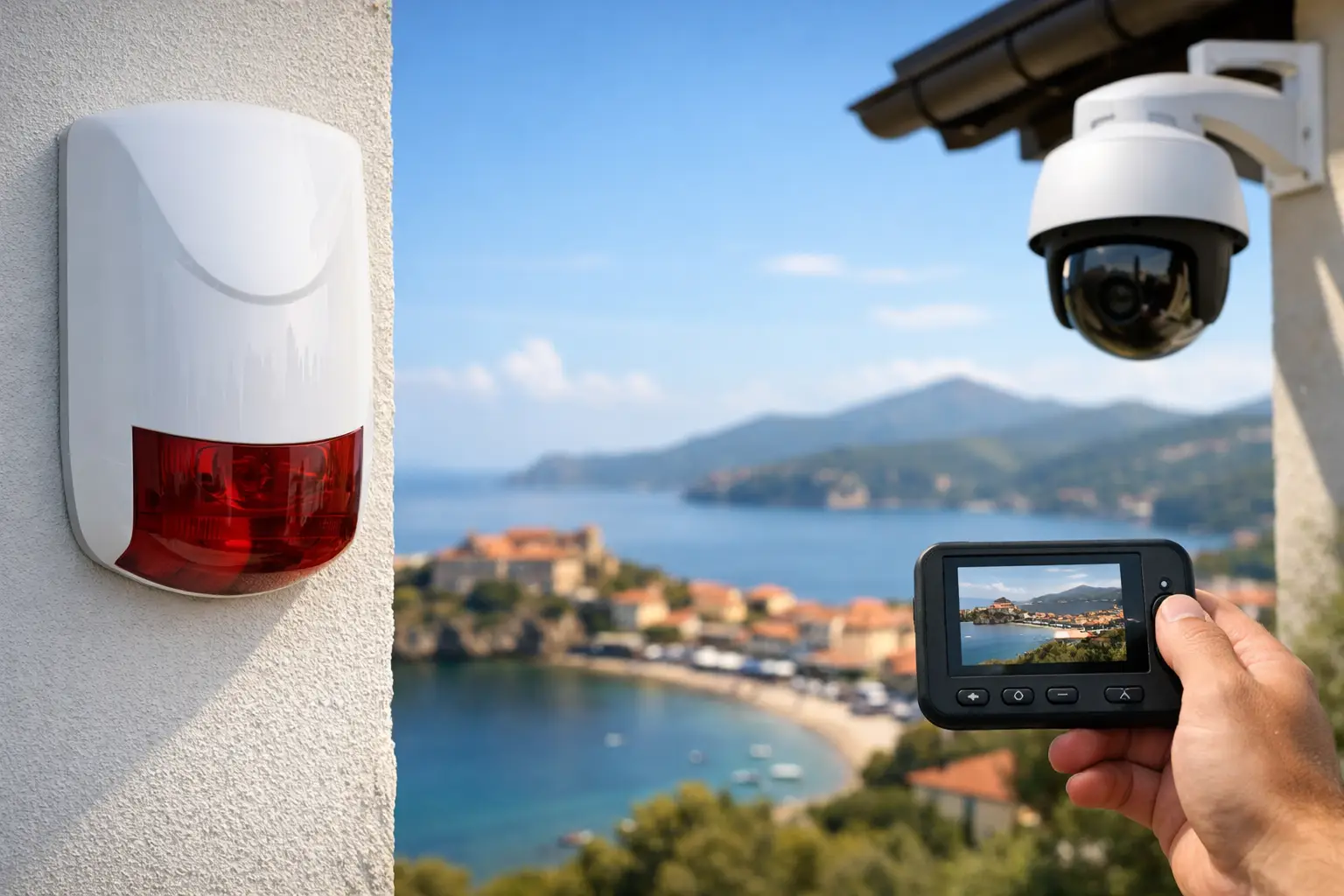
A second home that is closed for weeks or months doesn't just need a deterrent: it needs someone who can verify what is actually happening. When considering an alarm system or local monitoring on Elba, the best choice depends on the type of property, its location, and, above all, how often it remains unattended. An alarm system can signal an event; a local presence can check, intervene, and update the owner continuously.
For a villa, a holiday apartment, or an empty house on Elba Island, effective protection rarely comes down to a single solution. It's the coordination between technology, scheduled checks, and a reliable local contact that truly reduces uncertainty.
Alarm System or Local Monitoring on Elba: Two Different Functions
An alarm system is a technological tool. Sensors for doors and windows, motion detectors, sirens, cameras, and smartphone notifications can deter intrusions and signal openings or anomalies. For an owner living far away, knowing they will receive an immediate alert is useful and often necessary.
However, an alarm cannot by itself verify if an event is real, if a window was left ajar after a windy day, or if a water leak has appeared. If it triggers while the owner is abroad or many hours away from Elba, a concrete question remains: who goes to check?
Private security, when provided under contract with an authorized institute, can offer patrols or interventions upon notification. This solution should be considered especially for exposed properties, high-value assets, or those located in areas with limited traffic during quieter periods. However, it does not replace the ordinary care required by an unoccupied home.
A scheduled local check has a different objective: to observe the general condition of the property, identify small problems before they become costly, and maintain a constant presence. It is not armed surveillance, nor should it be presented as such. It is preventive property care, with checks carried out by a person who knows the home and the island's context.
What an Alarm System Can Do and Where Its Limits Lie
A good alarm system protects access points and makes it more difficult for intruders to act undisturbed. It can be connected to a monitoring center, send notifications, and integrate video devices. If the property is also used in winter or is left vacant between stays, it provides a sensible security baseline.
Its limitation is that it registers or signals a condition, but it doesn't solve the problem on site. A motion notification could be due to an intrusion, but also to an animal, an activation error, or a misaligned camera. A power outage alert won't reactivate the system. A humidity sensor won't repair a leak. A siren won't check if, after a storm, water has entered through a damaged shutter.
Then there's the issue of maintenance. Replacing batteries, unstable internet connections, updates, misaligned sensors, and false alarms can make a system less reliable precisely when it's most needed. For those living far away, leaving everything to technology often means receiving an alert without the ability to quickly assess it.
When Private Security is Appropriate
Private security might be suitable when the risk of intrusion requires a structured security presence or an organized response to an alarm. This decision should be made considering the property's location, access points, valuable contents, period of disuse, and the conditions of available services in the area.
Not all homes on Elba have the same needs. An apartment in a condominium inhabited year-round is different from an isolated villa with a garden, gates, and multiple access points. Similarly, a property frequently used by its owners requires a different setup than a house closed from October to Easter.
It's useful to thoroughly verify what the potential security service includes: hours, intervention methods, estimated response times, area coverage, and key management. Expectations must be clear. Occasional patrolling is not equivalent to thorough checks of interiors, system status, and the daily conditions of the house.
The Value of Scheduled Local Checks
A home-watching visit isn't about waiting for an emergency. It's about intercepting signals that an alarm system, a camera, or a neighbor might not detect. During a periodic check, attention can focus on doors, windows, shutters, signs of dampness, external conditions, accumulated mail, visible anomalies, and the general state of the property.
The frequency should not be chosen automatically. A seaside home, more exposed to wind, salt spray, and humidity, may require different checks than an apartment in Portoferraio or a property regularly used by the family. The age of the property, the presence of a garden, the season, and the duration of absence also influence the checking plan.
The most reassuring aspect is continuity. Someone who visits a property regularly can more easily notice what has changed: a newly appeared infiltration, a dislodged shutter, an anomalous meter reading, a branch fallen after bad weather, or an access point that no longer seems secure. Early intervention limits damage, costs, and downtime for the home.
The Most Effective Solution is Often a Combination
Choosing between an alarm system and local monitoring doesn't have to be an either/or decision. For many non-resident owners, the most balanced setup combines a well-maintained alarm system with regular local checks. The alarm provides a quick alert and a deterrent; the on-site check adds concrete assessment and the ability to coordinate subsequent steps.
If there is also a private security service appropriate for the property, it can complement this structure in cases where a security intervention is necessary. But it should not make one forget the daily needs of the house: ventilation when appropriate, checks after weather events, monitoring for potential leaks, and verification of real conditions between stays.
Elba Property Care operates exclusively for properties on Elba Island with a programmed supervision approach. The owner retains control of decisions, while having a local contact person who observes, communicates, and reports promptly. This presence does not replace law enforcement, specialized technicians, or security institutes, but it helps involve them promptly when necessary.
How to Decide for Your Second Home
The useful question isn't just "how protected is my home?" but "what happens when something goes wrong and I'm far away?" From this perspective, a more realistic choice emerges.
If the property is well-frequented, located in an inhabited area, and has a reliable alarm system, less frequent but constant checks might suffice. If, however, the house remains closed for long periods, has extensive outdoor spaces, is isolated, or contains systems requiring attention, it is advisable to increase the frequency of visits and evaluate additional measures.
Before activating any service, it's useful to define who holds the keys, who is contacted in case of anomaly, which interventions can be authorized, and how quickly the owner wishes to receive updates. These seemingly simple procedures prevent delays precisely when distance matters most.
A home on Elba should welcome its owner, not present them with surprises upon their arrival. The most reliable protection is not the one that promises to prevent every unforeseen event, but the one that ensures local attention and clear actions when truly needed.